agents delivered by light

Talk to a chip.
It comes alive
by light.

Describe what your board should do in plain English. BeamClaw writes a tiny program and beams it through your screen's light to a $3, radio-less Arduino — which then runs it forever, offline. No IDE. No USB cable. No WiFi. No app to install.

no radio runs in 2 KB $3 chip + 50¢ sensor one screen → many chips
LINK OPTICALRATE ~10–15 bpsRADIO noneCLOUD $0
498 B
RAM the runtime uses
2 KB
total chip RAM
45/45
decoded @ 70% loss (sim)
$0
cloud cost, forever
// SEQ.01 — ONBOARD
get started in 3 steps

From a sentence to a living chip — in two minutes

01
01 · once

Flash it, once

Plug your Arduino Uno in and click Flash my Arduino. One press in your browser installs BeamClaw — no Arduino IDE, no toolchain. You never flash again.

02
02 · say it

Say what you want

Open the console and type it plainly: "blink when it gets dark," "buzz on motion." The built-ins are free and instant; add your own AI key for anything you can describe.

03
03 · beam it

Hold it to the screen

Press Beam. Your screen flickers the program as light; a 50¢ sensor on the chip reads it. The board confirms, stores it, and runs it forever — unplugged.

// SEQ.02 — PIPELINE
how it actually works

The model thinks once. The chip acts forever.

compile

Words become a program

You describe a behaviour; BeamClaw turns it into tiny, safety-checked bytecode — assembly you never have to see, and a validator that refuses anything unsafe before a single bit leaves your screen.

beam

Light carries the code

The screen flashes black-and-white; a photoresistor on the chip decodes it. No radio, no pairing, no cable — and because light is a broadcast, one screen can program a whole room of chips at once.

run

It lives on its own

The chip stores the program and runs it in a 2 KB virtual machine, reacting to its sensors — offline, indefinitely. Re-beam in seconds whenever you want it to do something new.
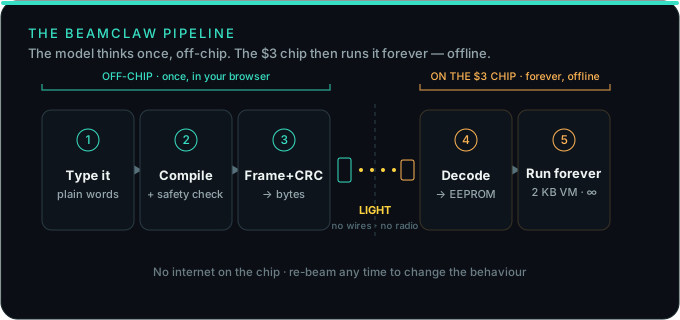
BeamClaw pipeline: type, compile and safety-check, beam by light; the 2KB chip decodes, stores, and runs it forever
See it in action
demo clip — the screen flickers, the board comes alive (coming soon)
// SEQ.03 — RATIONALE
why beamclaw

The corner of the world the cloud can't reach

🔦

No radio, at all

Works air-gapped, in a Faraday cage, on a factory floor, or anywhere WiFi is banned or absent. Nothing to pair, no network, no credentials to leak.

🐜

Fits in 2 KB

The whole runtime uses 498 bytes of RAM on a $3 chip — measured by the compiler, not guessed. Roughly 200× lighter than a WiFi-agent board.

♾️

Offline forever

The AI compiles your behaviour once, off-chip. After that the board needs no connection, no account, and no cloud — ever. Zero running cost.

📡

One screen → many chips

Light is a broadcast medium. Hold a dozen boards up to one monitor and program them all in the same flash. Try that over USB.

🗣️

Just talk to it

No IDE, no libraries, no compiler install. Describe what you want in a sentence; it compiles, safety-checks, and beams. Beginners ship in minutes.

Receipts, not slogans

The VM is cross-checked C↔JS, the optical link decodes through 70% packet loss in simulation, and the firmware provably fits 2 KB. We show our work.

// SEQ.04 — COMPARE
an honest comparison

Different on purpose

BeamClawESP-Claw / MimiClawUSB (Firmata)
RadiononeWiFi requirednone (wired)
Chip RAM2 KB≥400 KBany
Runs offlineforeverneeds the cloudneeds a host PC
How code arriveslightWiFi / flashcable
Program many at onceyes — one screennono
Receiver cost~$3 + 50¢~$5–10board + cable

We're not claiming to beat the cloud Claws on raw features or speed — they're powerful where there's WiFi and RAM to spare. BeamClaw owns the niche they can't serve: radio-less, 2 KB, light-delivered, offline. Built on the shoulders of OpenClaw, ESP-Claw, MimiClaw, the Timex Datalink, ggwave & Microvium.

// SEQ.05 — FAQ
quick answers

Questions people ask first

Q1 Can you really program an Arduino with light?+
Yes. Your screen flashes the program as on/off light and a 50¢ photoresistor on the chip decodes it — no cable, no radio. It's slow (~10–15 bits/sec), but it only has to run once: compile once, run forever.
Q2 Do I need the Arduino IDE?+
No. You flash BeamClaw to the board one time straight from your browser, then change its behaviour by light from any device — phone, tablet, or laptop.
Q3 Is an AI running on the chip?+
No — that's impossible in 2 KB, and we won't pretend otherwise. The AI compiles a tiny program off-chip; the chip just runs it. "LLM-compiled agency," not "an LLM on the chip."
Q4 Does it cost anything to run?+
Nothing. There's no server and no cloud. The built-in behaviours are free; for free-form AI you bring your own key and it talks straight to the provider — nothing billed to us.

More in the docs: wiring, the full instruction set, limitations & the roadmap.